
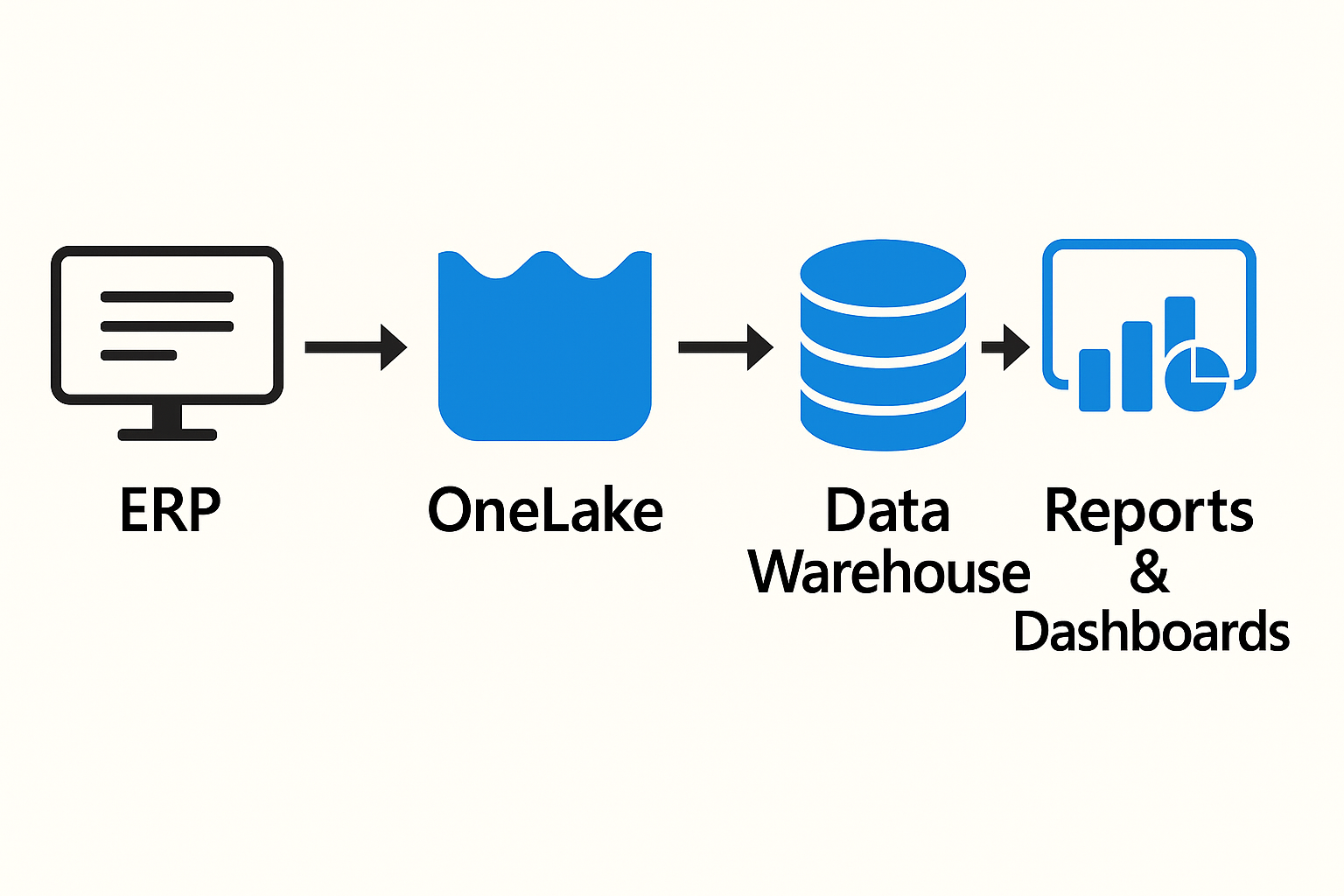
Many companies in the SME sector have been relying on traditional Data warehouses, to extract their ERP data from Dynamics NAV, Navision or Business Central evaluate. The advantage: structured tables, clear models and fast queries with SQL. The disadvantage: these systems are often cumbersome, expensive and require complex ETL processes.
With the Data Warehouse in Microsoft Fabric Microsoft is launching a modern solution that combines both worlds: Cloud scalability and Classic SQL analysis.
What makes the Fabric Data Warehouse special?
Serverless architectureNo more managing your own servers, resources are scaled automatically.
Direct integration with OneLakeAll data stored in OneLake can be used immediately in the warehouse - without copies.
Familiar SQL languageDevelopers and analysts can continue to work with SQL as they are used to from classic systems.
Seamless connection to Power BIReports access the warehouse directly, without additional interfaces.
Why is this exciting for NAV, Navision and Business Central?
ERP systems contain huge amounts of structured data: Bookings, orders, article master data, stock movements.
With the Data Warehouse in Fabric, companies can:
This data in real time from OneLake.
Complex KPIs (e.g. contribution margins, cash flow calculations) directly in SQL.
Combine data from NAV or Business Central with other sources (e.g. CRM or production systems).
Advantages for SMEs
Simple administrationLess IT effort, as Fabric takes over the hosting.
Cost efficiencyBilling is based on usage - no fixed license costs for database servers.
FlexibilityReports can be adapted quickly without the need for months-long projects.
Future securityFabric combines classic SQL queries with modern scenarios such as AI and machine learning.
The Data Warehouse in Microsoft Fabric is the bridge between the familiar world of classic SQL analyses and the flexibility of modern cloud platforms.
For companies with Dynamics NAV, Navision or Business Central This means familiar queries, less IT work - and the ability to use their ERP data even more efficiently for decision-making.
Do you have any questions or would you like to find out more about our methods? Get in touch with us - We show you how you can use your data for sustainable success.